
OpenClaw vs. Slackbots: Why Agentic AI Is the Future of Teams
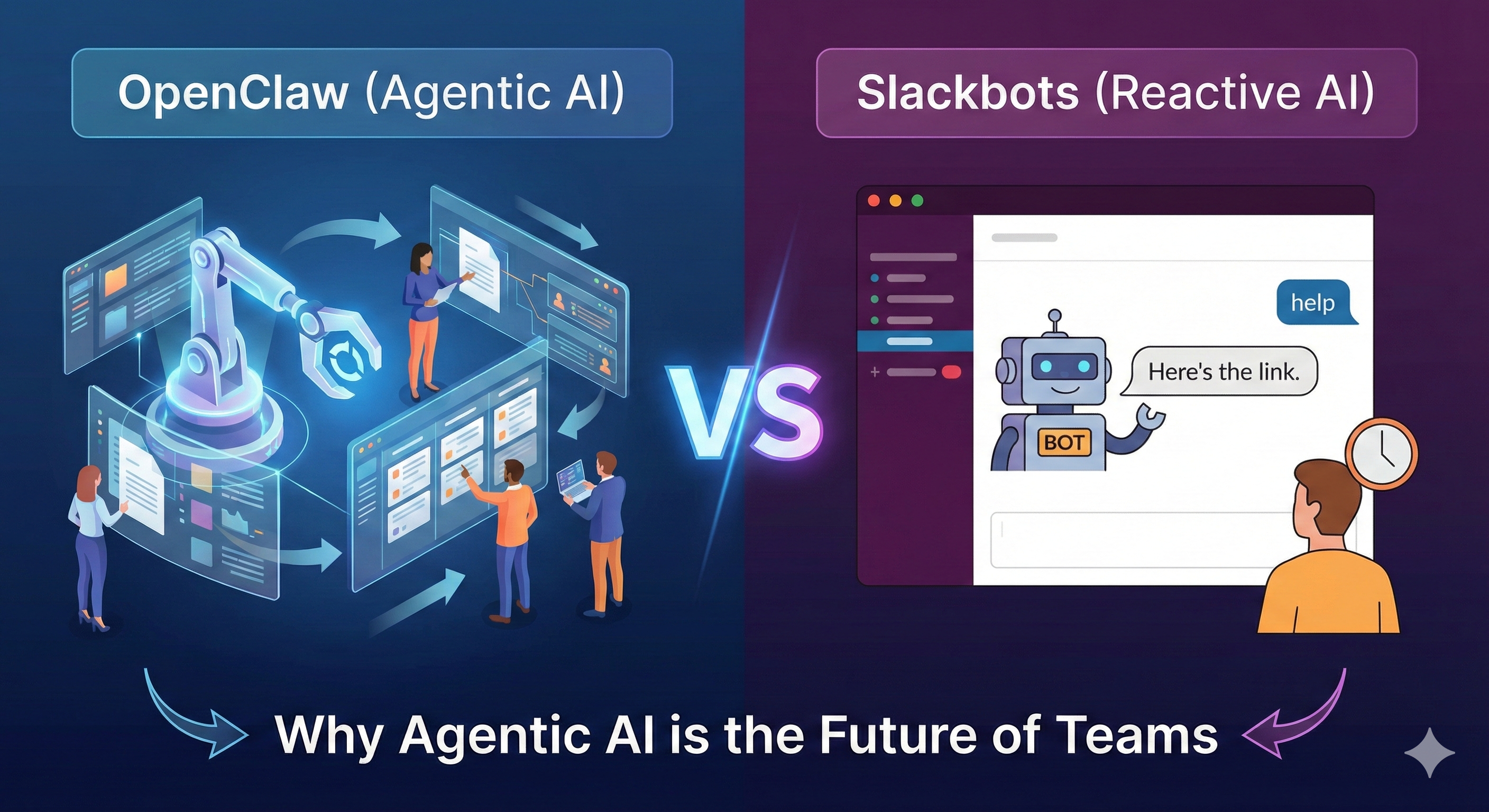
For nearly a decade, Slackbots have been the backbone of workplace automation.
They send reminders.
Trigger workflows.
Post alerts.
Answer basic questions.
But in 2026, teams are hitting a ceiling.
Because Slackbots aren’t autonomous.
They’re reactive.
And that’s where agentic AI — systems like OpenClaw — are redefining how teams operate.
If you're new to the concept of autonomous systems, our breakdown of What Is Agentic AI? explains the shift from chatbot responses to action-driven execution.
This article dives deeper into:
The architectural differences
Real productivity impact
Security implications
Cost tradeoffs
Why Slackbots are plateauing
And why agent-based systems are scaling
The Core Difference: Reactive Bots vs Autonomous Agents
Slackbots: Event → Trigger → Response
Traditional Slackbots operate on:
Keyword triggers
Slash commands
Workflow automation rules
API callbacks
They respond when prompted.
They do not:
Maintain persistent memory across projects
Strategically plan multi-step reasoning
Self-initiate actions
Route across multiple LLM providers
Coordinate with other agents
Slackbots are automation tools.
Not AI agents.
OpenClaw: Context → Reasoning → Execution
OpenClaw runs as an autonomous agent layer.
It can:
Monitor multiple channels
Maintain long-term context
Execute multi-step plans
Access external APIs
Switch LLM providers dynamically
Trigger workflows across systems
Self-correct when tasks fail
If you're evaluating how OpenClaw compares to other automation ecosystems, see OpenClaw vs Zapier Central Workflow Automation.
Slackbots automate single events.
OpenClaw orchestrates workflows.
That distinction defines the future.
Real-World Example: Customer Support Team
Slackbot Workflow
User posts issue in #support
Slackbot posts canned response
Human triages manually
Human opens helpdesk ticket
Human assigns agent
Automation assists — but humans still carry execution.
OpenClaw Workflow
Detect support message
Classify urgency
Cross-reference CRM history
Draft personalized response
Create helpdesk ticket
Assign based on workload
Schedule follow-up
Log resolution notes
No manual triage required.
If you’re building Slack-based automation pipelines, you may also want to explore our guide on Managing Discord Communities with OpenClaw, as similar principles apply across messaging platforms.
Why Slackbots Plateau at Scale
Slackbots work well for:
Reminders
Form submissions
Simple routing
Static workflows
But they break down when:
Context spans multiple threads
Tasks require reasoning
Decisions depend on memory
Multiple systems must coordinate
You need fallback logic across AI providers
For a technical breakdown of how OpenClaw handles LLM orchestration and fallback models, see Advanced OpenClaw Routing with Multiple LLMs.
Slackbots call a single API.
OpenClaw builds decision trees.
The Rise of “Team Memory”
One of the biggest differences in 2026 is persistent AI memory.
Slackbots typically operate statelessly.
OpenClaw can:
Remember project decisions
Track unresolved issues
Monitor task ownership
Reference previous Slack threads
Detect recurring blockers
If you're scaling team usage, understanding memory management is critical. Our guide on Manage Memory & Context Windows in OpenClaw explains how persistent context prevents dropped workflows.
Memory turns automation into intelligence.
Security Considerations: Slack vs Self-Hosted Agents
Security is often cited as Slack’s advantage.
It’s centralized.
Enterprise-managed.
Permission-based.
But that also means:
Full dependency on Slack infrastructure
Limited customization
Data hosted externally
OpenClaw introduces:
Local execution options
Private LLM routing
Self-hosted deployment
Custom permission layers
However — misconfiguration can expose risk.
Before deploying OpenClaw publicly, consult the Ultimate OpenClaw Security Checklist 2026.
The tradeoff is control vs convenience.
Cost Comparison: Slackbots vs Agentic Systems
Factor | Slackbots | OpenClaw |
Hosting | SaaS included | Self-hosted or cloud |
Customization | Limited | Extensive |
API Costs | Per integration | Per LLM call |
Scaling Complexity | Low | Moderate |
Long-term Flexibility | Limited | High |
Slack’s pricing is predictable.
OpenClaw’s costs depend on:
Token usage
Local compute
Multi-agent orchestration
API routing
But over time, agent systems reduce manual labor significantly more.
The Strategic Shift: From Bots to Autonomous Teams
Slackbots augment teams.
Agentic AI participates in teams.
This difference matters because:
Workflows are becoming multi-system
Teams are remote and distributed
Context fragmentation is rising
Decision fatigue is increasing
Manual coordination wastes hours weekly
OpenClaw acts less like a bot and more like a digital operations coordinator.
It doesn’t wait for commands.
It monitors, reasons, and executes.
When Slackbots Still Make Sense
Slackbots are sufficient when:
Workflows are simple
You don’t need memory
Compliance requires SaaS-only tools
You want zero infrastructure management
Automation complexity is low
But for:
Multi-channel orchestration
Cross-system intelligence
Persistent team memory
AI-driven workflow execution
Agentic systems win.
The Future of Teams (2026 and Beyond)
In the next 3–5 years, we’ll likely see:
Micro-agents assigned per department
Persistent AI memory layers per organization
LLM routing based on task complexity
Agents monitoring Slack, email, CRM, and project tools simultaneously
Human teams acting as supervisors, not operators
Slackbots were version 1.
Agentic AI is version 2.
OpenClaw is part of that shift.
Final Verdict
Slackbots automate tasks.
OpenClaw orchestrates outcomes.
If your team needs:
Structured reminders
Basic form workflows
Static automation
Slackbots are enough.
If your team needs:
Intelligent coordination
Cross-tool reasoning
Memory-based decision making
Autonomous execution
Agentic AI is the future.
And that future is already here.